Signature project · A connected learning experience
Pre-Algebra Guided Notebook & Learning System
A consistent foundation. Purposeful ways to practice. Support that changes as learners become more independent.
I see patterns, find the gaps, and build the bridge between them.
The design challenge
New demands. Unfinished foundations.
Learners are often expected to master increasingly complex material without secure foundational skills. Alongside the mathematics, they must interpret unfamiliar language, recognize problem structures, select strategies, and eventually perform independently.
I designed a connected learning system around those demands. The guided notebook anchors the experience; the instruction, practice, feedback, and support built around it help learners use what they understand.
Refined over three years and adopted across six classroom sections. These figures describe the scope of use; this case study documents design decisions and classroom refinements.
The anchor resource
A reliable place to return to.
The guided notebook provides organized explanations, worked examples, mathematical processes, and connected concepts. Learners add notes, follow examples, and return to familiar pages during instruction and review.
My “less is more” approach brings the key idea, visual models, worked examples, and practice into a focused reference page. Learners can find the step they need and see how the pieces connect without searching through a chapter.
The notebook is a record of their learning and a tool for using it. It gives learners a place to look and a next step to try before asking for help.
One page from the anchor resource. Visual grouping, worked examples, and space to practice keep the mathematical process in view.
The overarching goal
Understanding that holds when support disappears.
Learners ultimately need to recognize a problem, select a strategy, and apply it without relying on a notebook, partner, or instructor. The notebook supports learning and review; it is not available during independent standardized-style assessment.
Designed around the anchor
Connected components. Responsive decisions.
The objective connects the experiences. These components work together and are revisited as needed; they are not a fixed sequence or a daily routine.
Progressive challenge
I teach the underlying mathematical process before layering on additional language, unfamiliar formats, multi-step applications, word problems, and standardized assessment expectations. This helps me distinguish difficulty with the mathematics from difficulty with the way it is presented.
How I set the level of demand
I use Virginia Standards of Learning and performance level descriptors to understand the full performance demands. Those expectations inform the destination, while learners’ starting points shape the entry into the work. They do not all begin at the highest level.
Responsive support
Errors, hesitation, strategy selection, and learner independence help me decide when to model again, provide targeted support, regroup learners, or increase the challenge. Peer explanation and additional instructional support are used when available and productive.
What this can look like in practice
Whiteboard practice often includes two or three similar questions. That creates room for modeling, supported practice, and independent attempts as needed. The response to the work determines what happens next; the questions do not prescribe a fixed routine.
Purposeful variation
Partner work, whiteboards, scavenger hunts, self-checking activities, and interactive apps offer different ways to reinforce the same objective. I choose a format for its instructional purpose and for the people, resources, and conditions in the room.
Why the format may change
Collaboration can make reasoning visible through explanation or comparison. At other times, individual practice or an interactive task gives learners a more useful pace. The learning objective remains constant while the experience changes.
Feedback that builds independence
Self-checking opportunities let learners who need confirmation verify their work without always waiting for the teacher. This preserves instructional time for learners who need more substantial help and gives others a way to keep moving.
What I look for beyond a correct answer
I watch whether learners can identify the type of problem, choose an appropriate strategy, explain or revise their work, and apply the skill in an unfamiliar situation. Support is reduced as understanding develops, with independent performance remaining the goal.
Selected pages. Connected thinking.
Three selected pages show the anchor resource in use: a foundational process, its application in geometry, and a method that connects to proportional reasoning. Open a page to inspect the explanation, examples, and workspace.
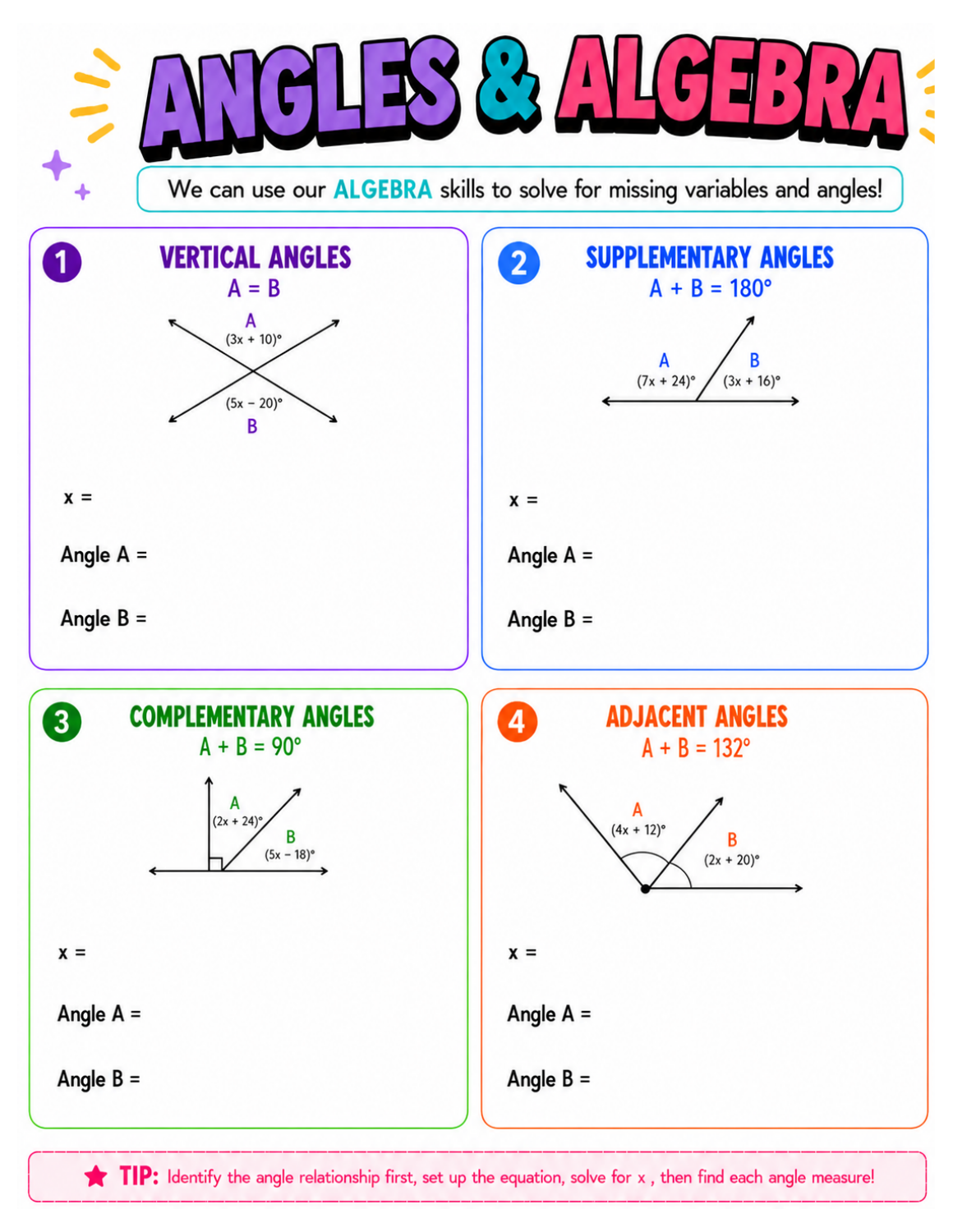
Combining Like Terms. Visual grouping and worked examples give students a method to follow during the lesson and revisit during practice.Angles & Algebra. Students use angle relationships to build and solve equations, applying their algebra skills in a different context.Proportions. Examples, guided practice, and scale-factor problems bring the method and its application together on one reference page. Printable PDF ↗
Interactive practice within the system
Make the thinking visible. Make feedback usable.
These two experiences connect visual models to symbolic reasoning and provide self-checking, adaptive practice. They give learners another way to work toward the same goal.
Expressions & Algebra Tiles — Endless Review
Tile models, signed quantities, and zero pairs make the structure of expressions visible. Learners build representations and identify equivalent expressions, with immediate feedback and adaptive difficulty supporting independent practice.
Two tile mats and an equals wall make balance and inverse operations visible. Self-checking feedback and adaptive practice support progression from preset representations toward independent model building and equation-solving.
A connected Pre-Algebra learning system brings together prerequisite skills, worked examples, accessible supports, practice, and checks for understanding. Refined through classroom use to build learner independence.
Students’ written work, questions, and strategy choices help me locate the difficulty: a conversion error, an unfamiliar term, a missed relationship, or a need for more practice. I use that information to clarify explanations and adjust the next task or the level of support.
The examples below make those decisions visible through a standards and prerequisite map, parallel partner practice, mixed-skill review, and language adaptations. They show how the system has been used and refined, without attributing measured learning gains to an individual resource.
I direct the instructional design, content, and quality review. AI supports exploration, drafting, and visual or technical production; I retain responsibility for the final materials and design decisions.
Explore classroom examples and design evidence
These examples show different design decisions within the system. They are selected resources, not a fixed lesson sequence.
Plan the sequence
Start with the skill beneath the standard.
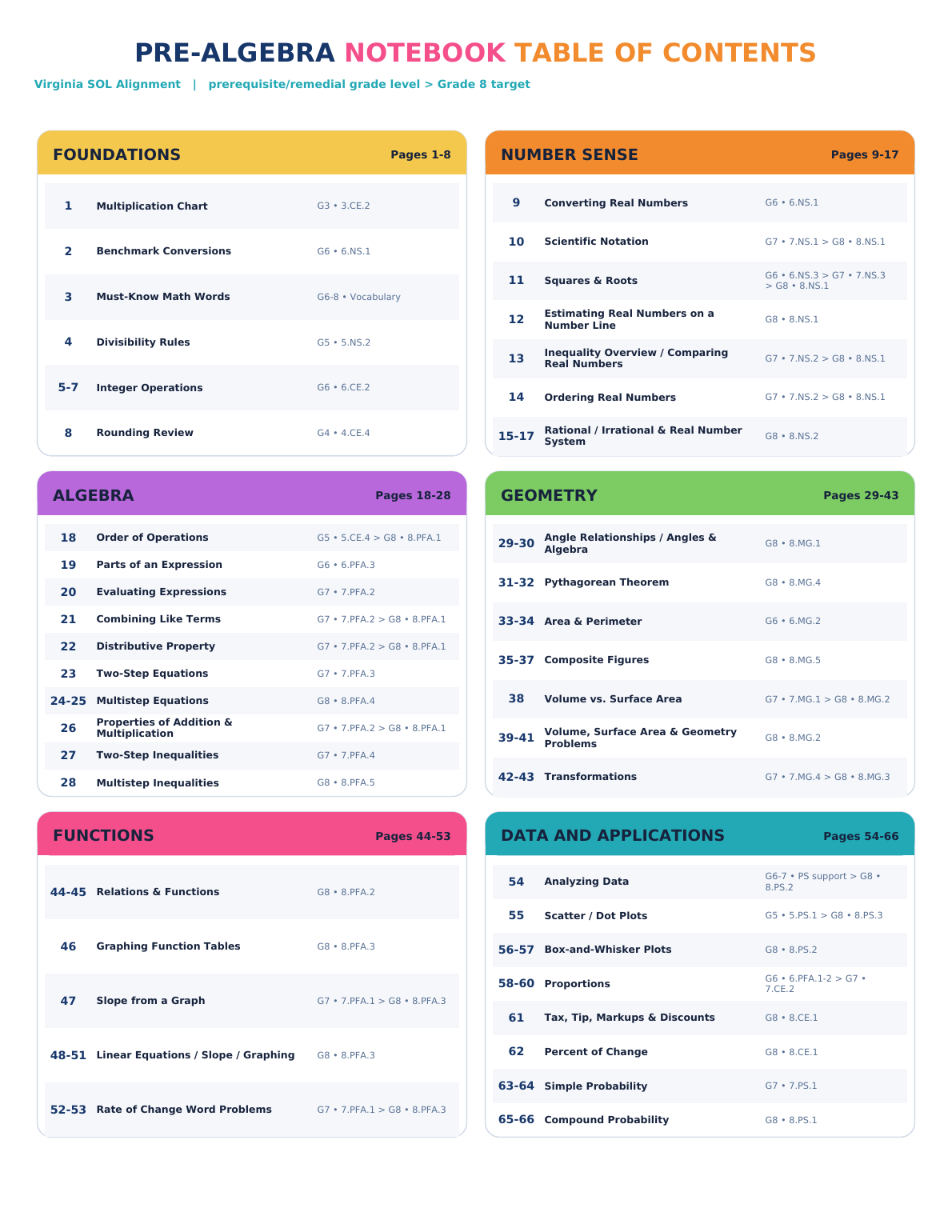
I mapped the notebook topics to Virginia Grade 8 standards and identified earlier-grade skills that students may need first. This makes the prerequisite visible instead of treating a Grade 8 target as a single isolated lesson.
Convert representations: the map places decimal, fraction, and percent conversions with Grade 6 number sense (6.NS.1).
Compare and order: Grade 7 number sense (7.NS.2) leads to the Grade 8 real-number target (8.NS.1).
This planning map reflects the original core sequence; later additions changed some page numbers. Open the standards map ↗
Review the building blocks
Revisit the skills before ordering.
These notebook pages come before the ordering lesson. Students review converting representations, interpreting square roots, and comparing values before they put different forms into one ordered list.
Convert real numbers. Change fractions and percents into decimals for comparison. Printable PDF ↗Review roots. Recognize exact roots and estimate non-perfect squares. Printable PDF ↗Compare values. Convert mixed forms before choosing which value is greater.
Design the page
Move from a model to a decision.
Each page has a job in the learning sequence. I pair plain-language explanations and visual models with worked examples, then give students a small step to try before asking for more independent work.
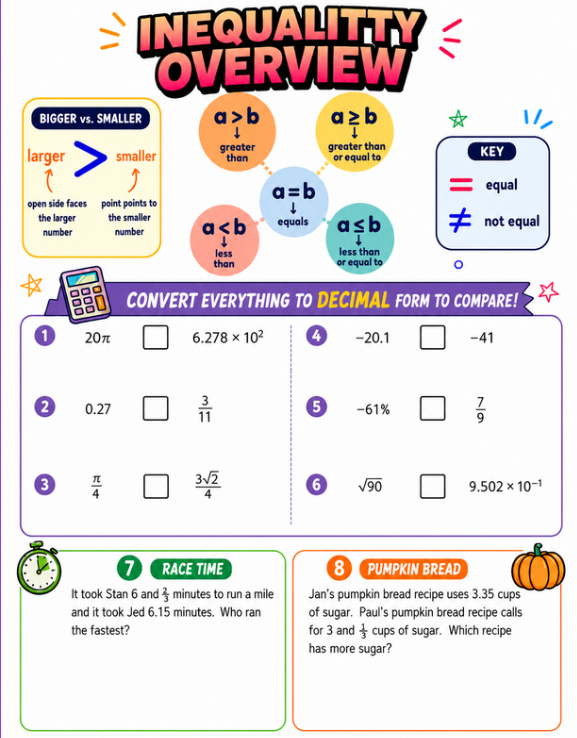
On this ordering page, students first decide whether the list is ascending or descending, separate positive and negative values, convert to decimals, and stack the results to compare. The partner check and team game below ask them to use that method with new sets of values.
Revise through use
The quick responses and students’ written work show where I need to clarify a term, revisit a visual, or adjust the next practice task. The notebook remains a reference students can return to as later topics build on earlier ones.
One ordering page: a four-step method and practice that leads into the partner task. Printable PDF ↗
Check for transfer
Use paired practice to see what students can do.
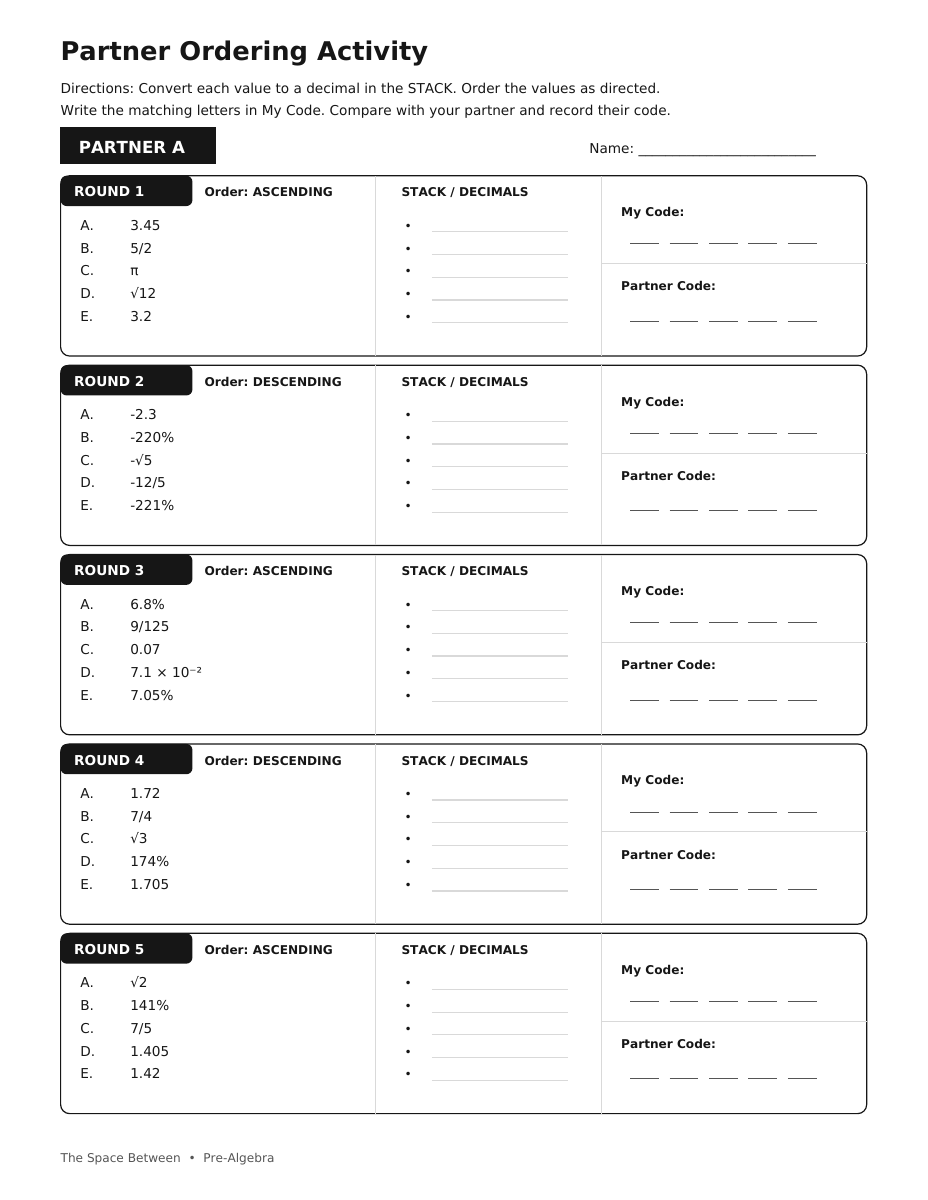
In the real-number strand of the notebook, students move from representing values as decimals to comparing and ordering them. This partner activity offers a parallel A/B check: each student converts five values, orders them, and compares codes with a partner across five rounds.
The work in the stack helps me see whether an error came from the conversion or the comparison. Partner A and B give students the same kind of challenge with different numbers.
Partner A preview. The PDF includes Partner B and separate answer-key pages.
Review in teams
Extend the practice through team review.
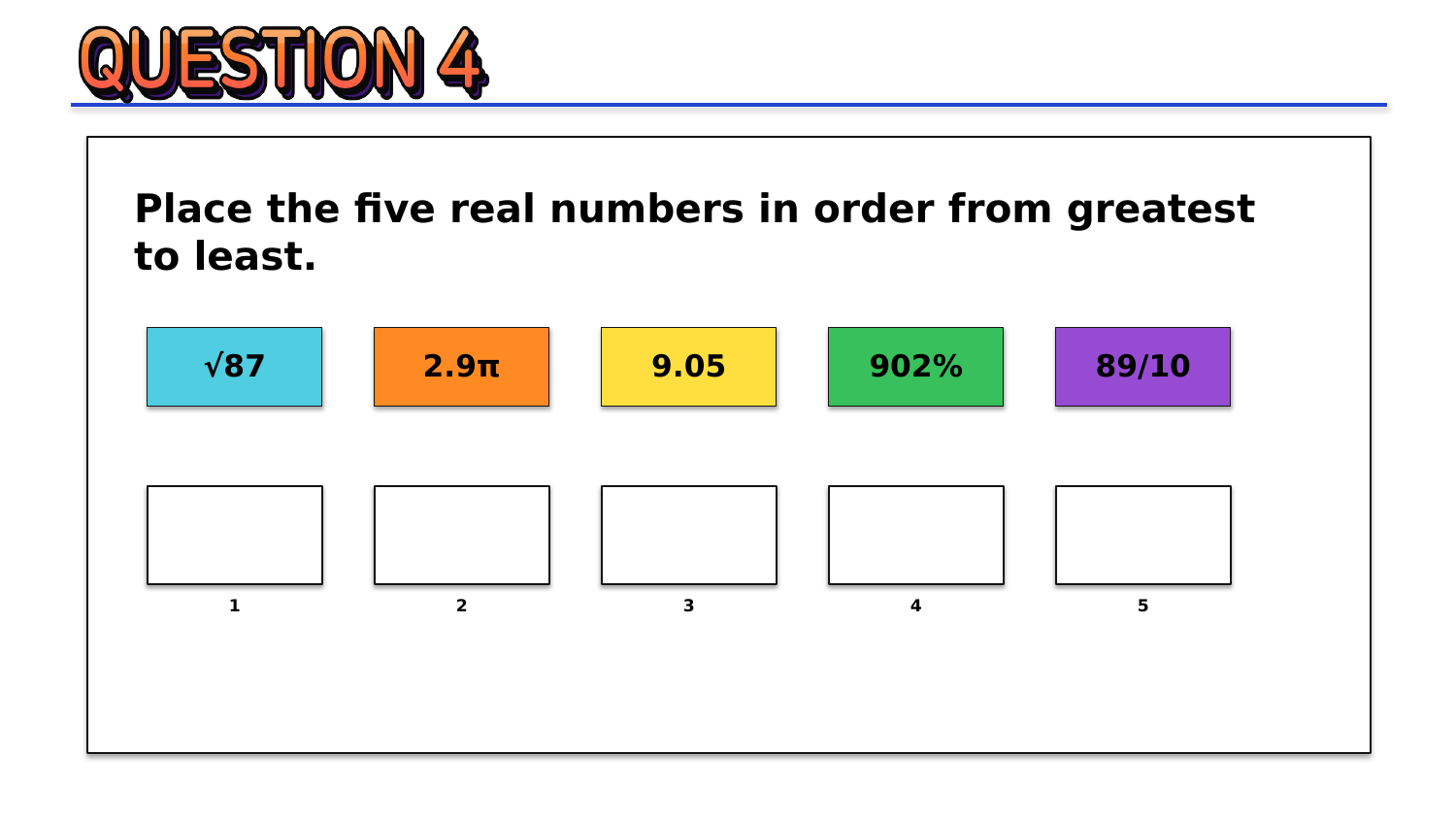
In the Real Numbers Team Challenge, every student solves a question before the team reveals answers together. The 16 questions mix ordering, comparing, estimating roots, and representing real numbers, so students have to choose the right approach rather than repeat one format.
One of the ordering rounds. The PDF includes the instructions, all 16 questions, and team score trackers.
Revisit with cards
Give the same skill more than one way to practice.
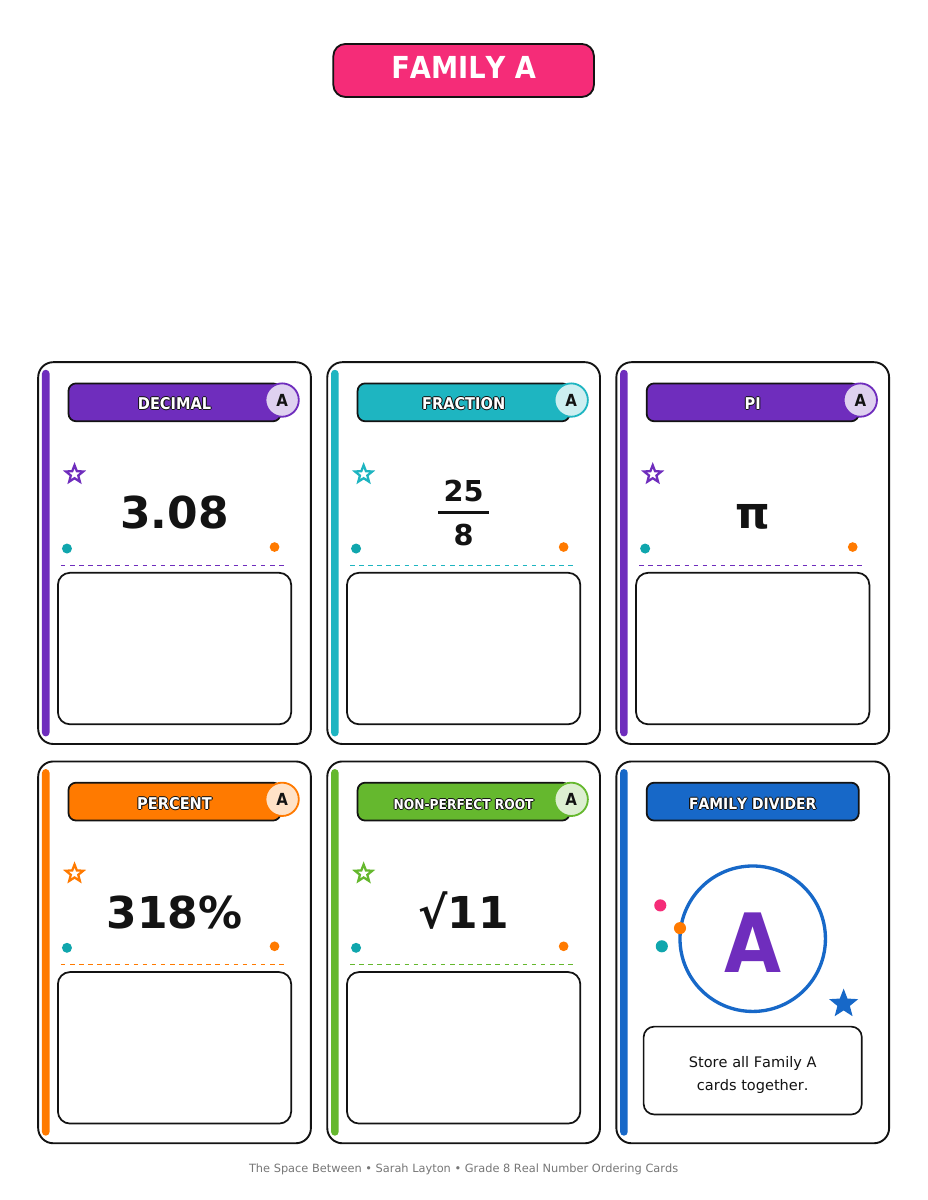
These lettered card families let students order a set with the same representation first, then work with mixed decimals, fractions, percents, roots, and π. A blank box on each card holds the conversion or estimate that explains the order.
Family A preview. The 21-page PDF includes teacher directions, practice options, and the full deck.
Make the lesson accessible
Give students another way into the same lesson.
Language support is one part of the notebook’s broader scaffolding. Alongside prerequisite review, worked examples, visual models, and guided practice, Spanish and Mandarin adaptations help students follow the same instruction while they are learning English.
I noticed one student writing on his page in Mandarin, then recording his answers in English. He was using his home language as a resource within the learning process. The adapted page gave him another way to engage with the work alongside his classmates.
These missing-dimensions pages show how that support fits into the system: the examples, diagrams, values, and mathematical challenge stay consistent across languages.
English · The same examples and mathematical challenge. Tap or click to enlarge. Printable PDF ↗Español · The same examples and mathematical challenge. Tap or click to enlarge. Printable PDF ↗中文 · The same examples and mathematical challenge. Tap or click to enlarge. Printable PDF ↗
The thinking behind the system
The structure is intentional. The support is flexible. Independence is the destination.